


Since I have this Substack and a YouTube channel that touches on introversion, I started hanging out in online introvert haunts to see what my fellow introverts discussed and what language they used.
Never assume your experience is the same as everyone else, right?
I’m not entirely sure what I was expecting, but I certainly wasn’t expecting such an onslaught of pessimism to the extent that it feels like introvert misery porn.
The Video
The video associated with this article is on YouTube.
What is an introvert?
So let’s briefly get into what being an introvert actually means before we continue.
Being an introvert means you get your mental energy from solitude, internal stimulation, and, for some, deep conversations with individuals or small groups. That is it. That’s all it means. It doesn’t imply social incompetence or disengagement. It certainly doesn’t mean you despise your fellow human beings. It doesn’t indicate loneliness or unhappiness.
The truth is, many introverts are socially skilled, connected, and confident. They’ll just be mentally knackered with too much of it.
I always recommend people read the book Quiet: The Power of Introverts in a World That Can’t Stop Talking, though I’m not sure I believe in the argument that the world is built for extroverts any longer, which is probably another article.
Now let’s continue.
What is introvert misery porn?
Introvert misery porn represents the online conversations I encounter in introvert communities. It’s always online; I don’t encounter it as much face-to-face. It overemphasises and dramatises the negative emotional experiences that people associate with their introversion.
It tends to frame introverted people as chronically misunderstood.
Some of the language they use around that is terrible. Socially disadvantaged? Is that really true anymore? Emotionally burdened, obviously, often in ways that encourage identification with suffering rather than understanding.
It doesn’t associate introversion with agency or growth. It turns introversion into a story of consistent struggle and victimhood. They don’t try to explore their introverted state; they just wallow in its negativity. The problem is that this doesn’t reflect my life experience, and I'm not convinced it has much to do with being an introvert.
This online community language focuses on:-
Introverts can’t function in a social world
Introverts are consistently exhausted or overwhelmed
Extroverts dominate everything
Introverts are doomed to loneliness
Being introverted is a burden or a flaw
These messages are misleading for several reasons.
First, they seem to be based on a stereotype. The sort of straw-man introvert that introverts define themselves against. The trouble is, it is a straw man, right? I just don’t get it. It seems to be the basis of internet discussions these days: describing yourselves through a taxonomy, but based on an extreme straw-man reference point.
Second, you read a lot of the conversation, and they’re talking about social anxiety disorders, shyness, or even forms of trauma that literally have nothing to do with being an introvert. Those are other things layered on top. Obviously they have these life experiences, but that doesn’t preclude putting on your adult pants to discuss what may be the actual cause of those experiences.
Third, and here we go, some of these personal preferences are personal preferences framed as pathology.
Is it an experience thing?
At first, I asked myself whether I was closer to this messaging at any point in my life.
I think there’s some truth that I was a bit closer to it when I was younger. If I look back to when I was younger, two things were true: I was very shy, and more socially anxious, especially in new situations where I’d be asked to do things I wasn’t comfortable or familiar with or didn’t know how to do it.
But that had nothing to do with me being an introvert. I could address those two things as social anxieties, rather than just being norms of my introversion.
As I moved through life and grew more confident through experience, my shyness was eradicated, and I now face new situations and moments of discomfort with complete confidence. You could even say, you know, a strange sense of discovery. It’s still true that I draw my mental energy from solitude, internal stimulation, and specific conversations with individuals and small groups.
I’m not prepared to describe my life in the context of the introvert misery porn narrative, but it is true that I experienced more moments of stress and discomfort due to these issues that age and life experience gave me the confidence to eradicate. So you could say, again, in a small way, my life was closer to elements of the introvert misery narrative when I was younger, even though I’d not consider myself a member of the club even back then.
Superpower as kryptonite
The introvert superpower is allegedly deep thinking. I don’t disagree with that as a concept, but they turn that very superpower into their kryptonite. I can use a thread from a channel that often posts content that lacks a certain uplifting introvert spirit, and he said that deep thinking about things led them all to be depressed.
I had to respond.
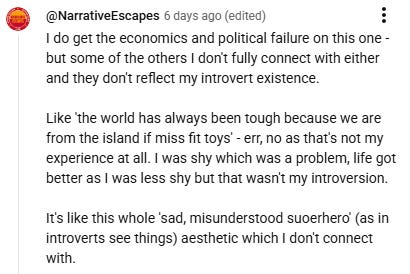
I certainly didn’t agree with the argument that introverts are from the “island of misfit toys.” I mean, what the hell is that? Are we Sid’s toys in Toy Story?

I got a response from another watcher who literally argued that introverts' deep-thinking nature was the source of the problem, and that the content creator was just being honest. Is it, though? You can’t allow something that should be a positive to become a sort of crippling weakness, because where does that lead you? How can allowing that to be the case lead you to a better life?
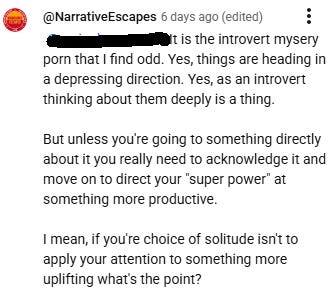
I responded, as the whole point of this propensity to deep think as a superpower is to deep think yourself out of problems, right? You have the power to change how you see the world. Move on and apply your supposedly vaunted superpower to something else that enhances your life.
Is it fear?
Once you get past social anxiety disorders being mistaken for introversion, you move on to what is fear being mistaken for introversion.
Let’s test two statements:
You get more introverted as you get older.
People are becoming more introverted.
You hear these statements all the time. I don't think either is true. They’re not becoming introverts; they’re just isolating, which isn’t the same thing as becoming introverted or actively choosing meaningful solitude.
You can replace the general statement that “people are becoming more introverted” with two things:
The general enshittification of how we interact with the world (apps, social media, crappy services) disconnects people.
They're being reclusive out of fear of where the world is going.
And I mean, I do sort of get that, but saying it’s something else isn’t representing the truth. We can’t equate introversion with fear of judgment, a lack of social cohesion, or avoiding life because of perceived threats. I don’t think introversion is increasing; I think anxiety, fear, overstimulation, and withdrawal behaviours are.
It’s about outcomes
As introverts, we need to be calm, confident, and balanced. So my framing isn’t “introverts are broken and misunderstood.”
We should see ourselves as thinking through depth and with intention. Whether we like it or not, we live in a social world, and I don’t see that as pain and rejection, but as being selective and finding meaning. So I don't see myself as a victim. I view my temperament as a tool I use consciously and wisely to move myself out of situations and into a better state.
It’s ultimately about outcomes.
We can leave ourselves feeling stuck in validated suffering, but I just don’t get how that helps. We have to move toward being centred, capable, and authentic, and march toward a road of inner peace and tranquillity.